
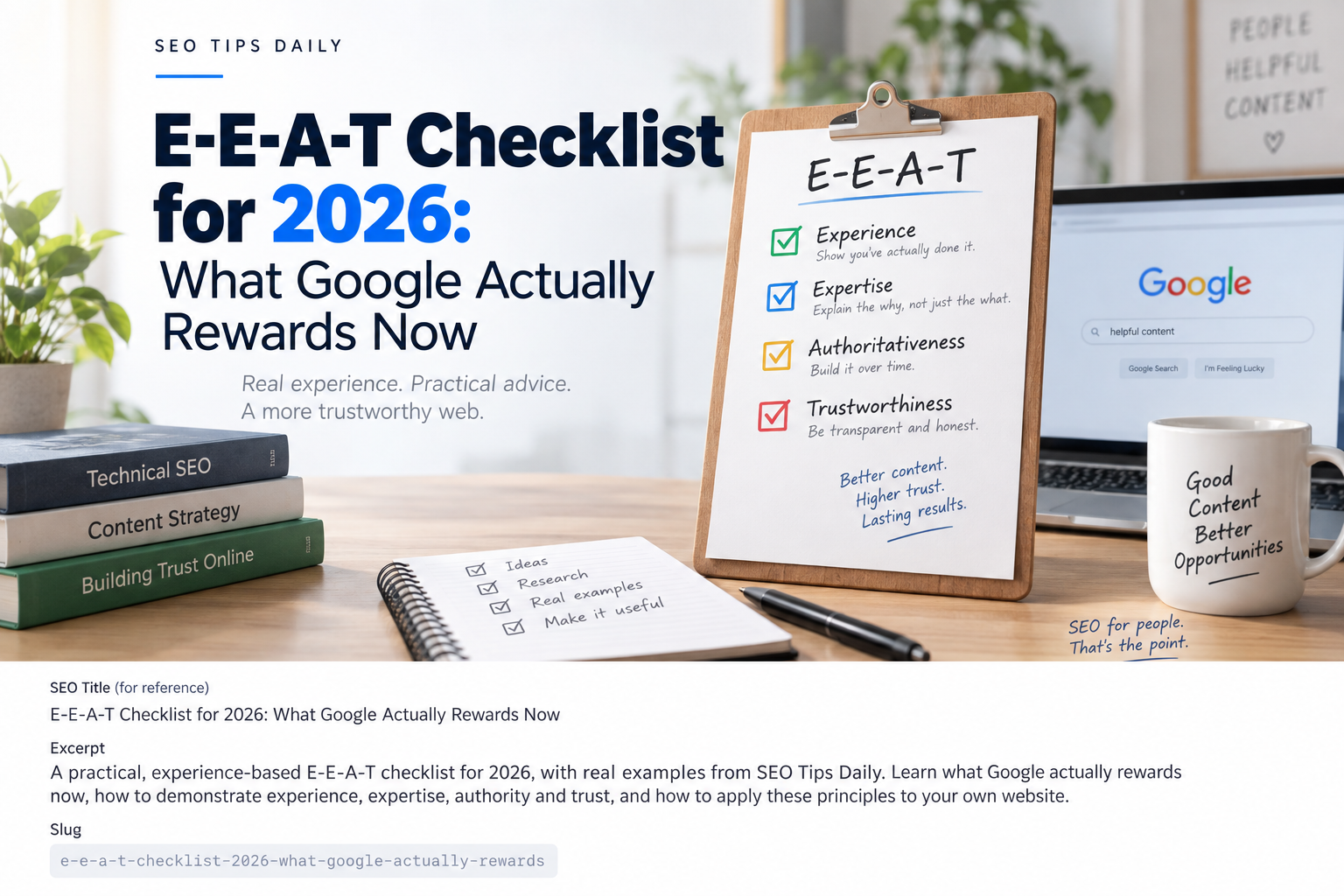
E-E-A-T Checklist for 2026: What Google Actually Rewards Now
If you’ve worked on SEO long enough, you’ve probably noticed something frustrating: doing all the “right” SEO things doesn’t necessarily mean Google will immediately reward a page.
We’ve seen this ourselves while working on websites.
A page can have a proper title tag, meta description, internal links, canonical URL, structured data and a technically clean layout—and still struggle to gain visibility.
At the same time, another page can begin attracting impressions even though it isn’t nearly as aggressively optimized.
Experiences like these have changed how we think about SEO.
Technical optimization matters. Keywords matter. Links matter.
But they aren’t enough on their own.
Increasingly, the question we ask before publishing something is:
Why should someone trust this page over the other pages already available?
That’s where E-E-A-T becomes useful.
E-E-A-T stands for:
Experience
Expertise
Authoritativeness
Trustworthiness
This isn’t a theoretical checklist we’ve created simply by reading SEO articles. It’s also a framework we’re using while improving our own publishing process at SEO Tips Daily.
And some of those improvements have come from mistakes.
First: Is E-E-A-T Actually a Google Ranking Factor?
This needs clarification because E-E-A-T is frequently oversimplified.
You shouldn’t imagine that Google maintains a public score such as:
E-E-A-T Score: 82/100
Google’s Search Quality Rater Guidelines use E-E-A-T as part of evaluating the quality of search results.
That doesn’t mean there’s a single E-E-A-T ranking signal that an SEO tool can measure for you.
The distinction matters.
Instead of trying to “increase an E-E-A-T score,” we’re more interested in improving the signals a real visitor can see:
Who wrote this?
Why should I trust them?
Have they actually worked with what they’re discussing?
Can I verify important claims?
Does the website clearly explain who’s behind it?
Would I bookmark this page if Google disappeared tomorrow?
That last question is particularly useful.
If the only reason a page exists is to capture search traffic, it usually shows.
A Lesson From Building SEO Tips Daily
One reason we wanted to publish this guide is that we’ve had to examine these issues on our own site.
While developing SEO Tips Daily, it became obvious that publishing useful articles alone wasn’t enough.
The surrounding website matters too.
We had to pay attention to things such as:
- Author attribution
- Author biographies
- Heading structure
- Duplicate H1 problems
- Clear ownership information
- Internal linking
- Content organization
- Technical SEO
- Whether readers could understand who was actually responsible for an article
These aren’t glamorous SEO tasks.
Nobody gets particularly excited about fixing a duplicate H1.
But think about the experience from a visitor’s perspective.
If you arrive on an SEO advice website and can’t tell who wrote an article, what experience they have, or who’s behind the publication, why should you trust their recommendations?
That was an important realization for us.
E-E-A-T isn’t something you add after publishing content.
It needs to influence how the entire website is built.
1. Experience: Prove You’ve Actually Done Something
The extra “E” in E-E-A-T stands for experience.
And this is an area where a lot of SEO content falls short.
Search for almost any SEO question and you’ll find articles repeating variations of the same advice.
We don’t want SEO Tips Daily to become another site doing that.
Our goal is to increasingly include things we’ve actually encountered while building, optimizing and troubleshooting websites.
For example, we’ve dealt with situations involving:
- Pages taking time to appear for their intended searches
- A blog article appearing for a commercial query instead of the intended service page
- Canonical and redirect configuration
- Structured-data errors
- Sitemap changes and resubmission
- WordPress performance optimization
- Website migrations
- Internal-linking changes
- Search Console impressions appearing before meaningful ranking improvements
These experiences are more useful than pretending SEO always follows a clean textbook sequence.
It doesn’t.
One practical example: the wrong page ranking
One particularly useful SEO lesson comes from seeing Google surface an informational blog page for a commercial query while the intended service page struggled to appear.
At first glance, that sounds like good news:
We’re ranking!
But it isn’t necessarily the result you want.
If someone has commercial intent and Google chooses your informational article instead of your service page, you need to investigate why.
Questions worth asking include:
Is the blog article internally linked more strongly?
Are both pages targeting almost identical search intent?
Does the service page provide enough unique commercial value?
Are internal anchors making the relationship between the pages unclear?
Is the blog page simply a better answer to what Google currently believes users want?
The important lesson wasn’t that there is one magic fix for “keyword cannibalization.”
The lesson was that rankings need interpretation.
A ranking position by itself doesn’t tell you whether your SEO strategy is working correctly.
That’s first-hand experience we can actually use when creating future SEO content.
2. Expertise Means Explaining Why
Anyone can publish a list of SEO recommendations.
Expertise becomes visible when you can explain why a recommendation makes sense—and when it doesn’t.
Take canonical tags.
A weak article might say:
Add canonical tags to improve SEO.
That’s technically related to SEO, but it isn’t particularly useful.
A stronger explanation would discuss what canonicalization is intended to communicate, when duplicate or near-duplicate URLs can become an issue, why redirects and canonicals aren’t interchangeable, and why blindly changing canonical URLs can create new problems.
The same principle applies to almost every technical SEO topic.
Don’t just tell readers:
Do X.
Explain:
Why X?
When should you do it?
When shouldn’t you do it?
How can you check whether it worked?
That’s the standard we’re trying to use for our technical content.
3. Authority Isn’t Something You Can Declare
You can’t put this in your footer:
SEO Tips Daily is an authoritative SEO website.
Well, technically you can.
It just doesn’t make it true.
Authority is earned gradually.
For a new publication, that means being realistic.
We’re not going to pretend SEO Tips Daily has decades of publishing history or thousands of independent citations if it doesn’t.
Instead, authority has to be built through the work itself.
That means publishing genuinely useful articles around subjects we understand, connecting related resources, correcting mistakes, showing who’s writing the content and gradually earning mentions and links from other websites.
Build topics, not random keyword collections
This is something we’re being particularly careful about.
Keyword tools can tempt publishers into creating articles about everything.
If a keyword has volume, someone wants to publish it.
But SEO Tips Daily should have a clear reason for existing.
So rather than jumping between unrelated high-volume topics, the stronger approach is to develop connected SEO resources.
For example:
Technical SEO
- Canonical URLs
- Redirects
- XML sitemaps
- Indexing
- Crawlability
- Structured data
- Core Web Vitals
Content SEO
- Search intent
- Keyword research
- E-E-A-T
- Content briefs
- Internal linking
- Content updates
- Keyword cannibalization
WordPress SEO
- WordPress performance
- SEO plugins
- Schema
- Image optimization
- Technical WordPress fixes
- Site migrations
One genuinely useful content cluster is worth more to our long-term publishing strategy than dozens of unrelated articles written simply because keywords exist.
4. Trust Starts With Being Transparent
This is perhaps the most important section of this entire article.
If we’re going to give SEO advice, readers should know who’s giving it.
That’s why we’re improving how authorship and ownership are presented across SEO Tips Daily.
A trustworthy content site should make basic questions easy to answer:
Who wrote this?
Who runs the website?
What experience does the author have?
How can I contact the publication?
When was this article written or meaningfully updated?
Where did important factual claims come from?
If those answers are difficult to find, that’s a website problem—not a reader problem.
5. Our Own E-E-A-T Mistakes
It would be strange to write an article about E-E-A-T while pretending we’ve implemented everything perfectly.
We haven’t.
During development, we’ve had to work on issues including thin author information, author attribution and heading structure.
None of these automatically means Google won’t rank a website.
That’s an important distinction.
We also can’t tell you that fixing an author biography caused rankings to increase by exactly 17%, because we don’t have a controlled experiment proving that.
And we won’t manufacture one for an SEO case study.
What we can say is that these issues made the site less transparent and less polished for readers.
That alone makes them worth fixing.
This is also an important E-E-A-T principle:
Don’t turn correlation into causation just because it makes a better SEO headline.
If we run a controlled SEO experiment in the future, we’ll publish the methodology and results.
Until then, we’ll distinguish observations from experiments.
6. Original Data Is Valuable—But Fake Data Is Worse Than No Data
SEO articles love percentages.
“Traffic increased 312%.”
“Rankings improved 47%.”
“Conversions increased 89%.”
Numbers look authoritative.
But without methodology, they can mean almost anything.
We would rather publish no statistic than invent one simply to make an article appear more credible.
When we publish original SEO data, we want readers to understand:
- What was measured
- Which website or dataset was involved
- What period was compared
- What changed
- What else changed during that period
- Whether the result is an observation or controlled test
Google Search Console provides plenty of opportunities for this.
For example, instead of eventually writing:
Internal linking improves rankings.
We could analyze a group of pages before and after a documented internal-linking change and report what actually happened.
Even then, we’d need to be careful about claiming causation.
That’s less exciting than promising a secret ranking trick.
It’s also much more useful.
7. Stop Publishing Articles Just Because a Keyword Has Volume
This is one of the rules we want to apply to SEO Tips Daily itself.
Finding a keyword isn’t a sufficient reason to publish.
Suppose a keyword research tool reports:
Monthly searches: 1,000
The obvious reaction is:
“Let’s write an article.”
But there’s another question we should ask first:
What can we contribute that isn’t already available?
Maybe we have:
- First-hand experience
- A better explanation
- Original screenshots
- An experiment
- New data
- A useful template
- A different opinion
- A real troubleshooting example
If the answer is “nothing,” we should reconsider publishing it.
The internet doesn’t need another rewritten version of the first five Google results.
8. AI Content Isn’t Automatically Bad—Low-Value Content Is
AI has made publishing dramatically faster.
That’s useful.
It’s also dangerous.
A publisher can now generate hundreds of articles much faster than a traditional editorial team could produce them.
But production speed isn’t the same thing as value.
We believe AI can be useful for things such as:
- Brainstorming
- Research assistance
- Organizing notes
- Creating initial outlines
- Identifying missing questions
- Editing
- Grammar checking
But the final article still needs editorial judgment.
Facts need checking.
Examples need to be real.
Opinions should come from actual reasoning.
Experience shouldn’t be invented.
If an AI system writes:
“When we migrated 50 enterprise websites…”
and nobody involved actually migrated those websites, that’s not E-E-A-T.
That’s fabrication.
Our rule is simple:
AI can assist the writing process. It shouldn’t manufacture experience.
9. Use Primary Sources Whenever Possible
SEO information gets distorted surprisingly quickly.
Google publishes something.
An SEO publication interprets it.
Another blog summarizes that publication.
Someone posts the summary on social media.
Then another article cites the social post.
Eventually the original meaning can be lost.
When discussing Google’s own policies or documentation, we prefer going back to primary Google documentation whenever possible.
The same applies elsewhere.
If we’re discussing structured data, Schema.org and Google’s documentation are usually more useful starting points than a random blog post.
Secondary sources can still be valuable—particularly for analysis and industry opinion—but they shouldn’t replace primary evidence when primary evidence is available.
10. Update Content When Reality Changes
An article shouldn’t be considered finished forever just because someone clicked “Publish.”
SEO changes.
WordPress changes.
Google documentation changes.
Interfaces change.
Plugins disappear.
Screenshots become outdated.
Recommendations that made sense two years ago may need qualification today.
Our maintenance checklist includes questions such as:
Are the screenshots still accurate?
Do external links still work?
Has the official documentation changed?
Have we learned something since publishing this?
Does the article still answer the search intent?
Can we add a real example that wasn’t available when the article was originally published?
And importantly:
Changing the date from 2025 to 2026 isn’t an update.
A meaningful update should improve the article.
11. Technical SEO Still Matters
E-E-A-T doesn’t replace technical SEO.
You could publish the best SEO tutorial on the internet, but if Google can’t crawl it properly, that’s a different problem entirely.
We’ve encountered enough technical website issues to take this seriously.
Our basic technical checklist includes:
- HTTPS
- Correct canonical URLs
- Sensible redirects
- Mobile usability
- Page performance
- Crawlable navigation
- XML sitemap
- Clean heading structure
- Useful internal linking
- Appropriate structured data
- Proper indexability
- Helpful 404 handling
Technical SEO doesn’t create expertise.
It helps ensure that your expertise isn’t being undermined by preventable technical problems.
12. Internal Links Should Help People, Not Just Crawlers
We use internal links for SEO, but that’s not their only purpose.
A useful internal link answers the reader’s next question.
If you’re reading about E-E-A-T and we mention keyword cannibalization, linking to a detailed guide about cannibalization would make sense.
If we mention canonical URLs, a canonicalization tutorial could be useful.
That’s a better approach than inserting exact-match anchor text purely because an SEO checklist says:
“Add three internal links.”
Context comes first.
13. Don’t Fake Trust
This sounds obvious.
Unfortunately, it needs saying.
Never invent:
- Authors
- Qualifications
- Clients
- Reviews
- Awards
- Case studies
- Testimonials
- Experiments
- Statistics
- Years of experience
If something is an observation, call it an observation.
If it’s an opinion, call it an opinion.
If it’s a controlled experiment, explain how the experiment was conducted.
And if you don’t know something?
Say you don’t know.
That’s not weakness.
That’s credibility.
The SEO Tips Daily E-E-A-T Checklist for 2026
Here’s the checklist we’re using as a benchmark for our own content.
Experience
☐ Does this article include first-hand experience where appropriate?
☐ Can we replace a hypothetical example with something we’ve actually encountered?
☐ Do we have an original screenshot, test or observation that would improve the article?
☐ Have we clearly separated experience from speculation?
Expertise
☐ Is the information accurate?
☐ Have we explained why the recommendation works?
☐ Have we explained important exceptions?
☐ Could a reader actually implement the advice?
☐ Have technical claims been reviewed?
Authoritativeness
☐ Is the author clearly identified?
☐ Does the author biography explain relevant experience?
☐ Is this topic relevant to the website’s overall focus?
☐ Do we have useful related articles?
☐ Are internal links helping readers explore the subject?
Trustworthiness
☐ Is website ownership transparent?
☐ Is there a useful About page?
☐ Is there a working Contact page?
☐ Are relevant policies available?
☐ Are important factual claims sourced?
☐ Are affiliate or commercial relationships disclosed where applicable?
☐ Have we avoided exaggerated claims?
Content Quality
☐ Does this page actually satisfy the search intent?
☐ Does it contain something beyond what’s already ranking?
☐ Are examples genuine?
☐ Have we removed unnecessary filler?
☐ Has the article been fact-checked?
☐ Does it read naturally?
☐ Is it useful on mobile?
Maintenance
☐ Is the publication/update date accurate?
☐ Do external references still work?
☐ Are screenshots current?
☐ Has outdated advice been removed?
☐ Can we improve the article using new experience or data?
Applying This Checklist to This Article
There’s an interesting test we can perform before publishing this page.
Does this E-E-A-T article pass its own checklist?
Originally, it wouldn’t have passed every item.
It contained useful explanations, but too many examples were hypothetical.
That’s exactly the kind of issue we’re trying to improve.
This version now includes first-hand observations from website development and SEO work, discusses real issues we’ve encountered, identifies areas where our own publishing process needed improvement, and deliberately avoids inventing statistics we can’t prove.
There’s still room to make it better.
For example, as we collect meaningful Search Console data, we can update this guide with screenshots and documented SEO observations.
That’s how we want this article to evolve.
Not by changing “2026” to “2027” next year.
By making the page genuinely better.
What Does Google Actually Reward?
There’s no secret E-E-A-T switch.
And there’s no plugin that turns an average website into an authoritative one overnight.
The better way to think about it is surprisingly simple.
Before publishing, ask:
Why does this page deserve to exist?
Then ask:
Why should someone trust us to provide this answer?
Then:
What have we added that another publisher couldn’t produce simply by rewriting the existing search results?
If you have convincing answers to those three questions, you’re probably heading in the right direction.
That might mean sharing your own data.
It might mean publishing screenshots.
It might mean explaining a mistake.
Sometimes it simply means writing a clearer answer than anyone else bothered to write.
SEO isn’t becoming less important.
But publishing generic content and adding keywords to it isn’t much of a competitive advantage anymore.
Final Thoughts
Working on our own websites has made one thing increasingly clear:
E-E-A-T isn’t a box you check after finishing an article.
It’s a publishing philosophy.
Show who wrote the content.
Explain why they’re qualified to discuss it.
Use real experience when you have it.
Cite reliable sources.
Separate observations from proven experiments.
Don’t invent data.
Fix technical problems.
Update articles when you’ve genuinely learned something new.
And don’t publish something merely because your keyword research tool says people search for it.
We’re applying the same principles to SEO Tips Daily.
This article isn’t meant to be the final word on E-E-A-T. As we collect more first-hand data, run SEO experiments and learn from the site’s performance, we’ll continue updating it with what actually happened.
Because if we’re going to tell readers to demonstrate experience rather than simply talk about it, we should hold our own content to the same standard.
About the Author
Saurav Daga is a full-stack web developer with more than a decade of experience working with websites and web applications, including PHP, WordPress, Laravel, JavaScript and modern web technologies.
His SEO work focuses on the practical intersection between development and search optimization—including technical SEO, website performance, indexing, structured data, redirects, canonicalization, WordPress SEO and diagnosing real-world website issues.
At SEO Tips Daily, the goal is to document practical SEO lessons, experiments and observations without presenting assumptions as proven results.