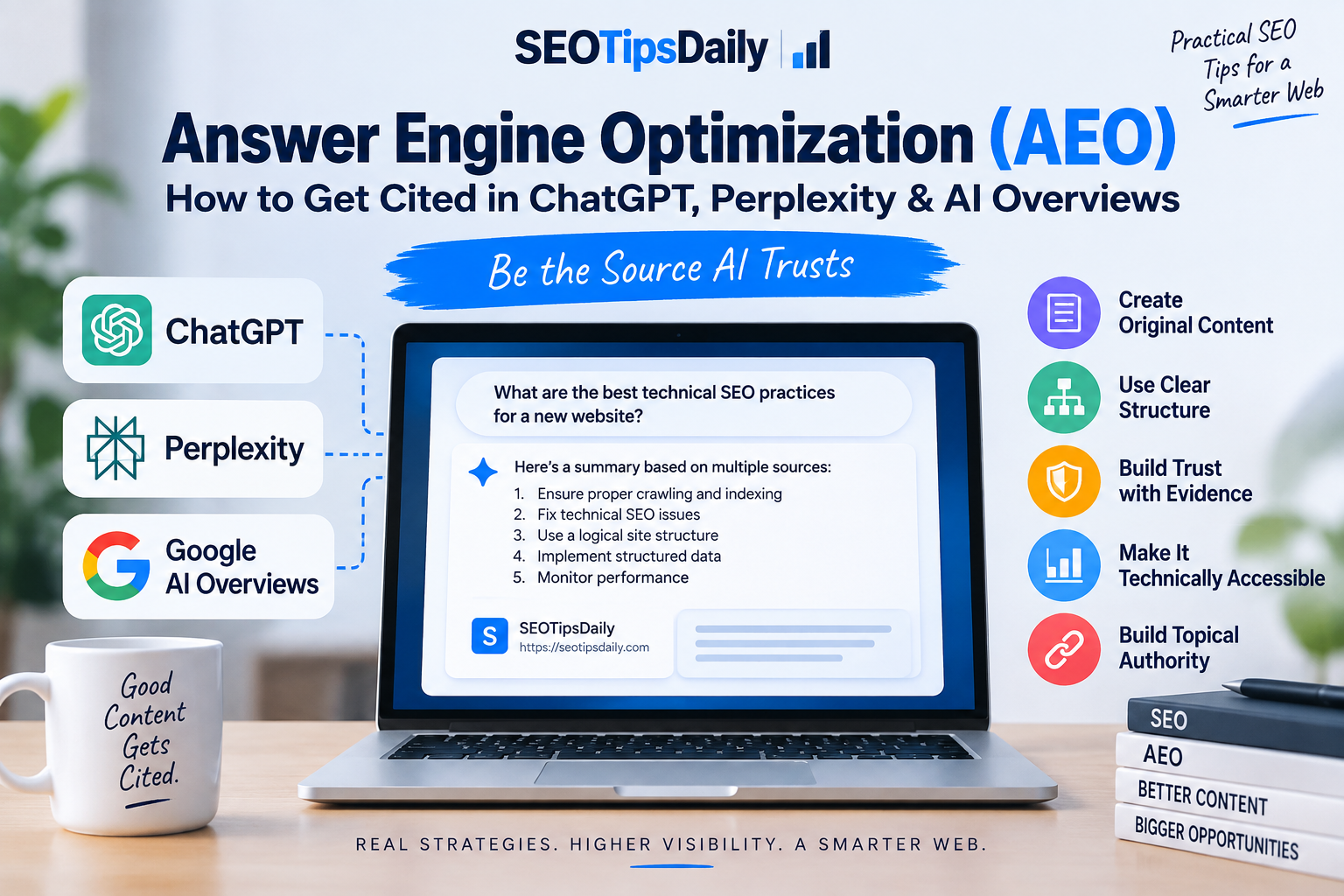
Answer Engine Optimization (AEO): How to Get Cited in ChatGPT, Perplexity & AI Overviews
Answer Engine Optimization (AEO) refers to the practice of making your content easier for AI-powered search and answer engines to discover, understand, trust and cite. Building visibility with ChatGPT, Perplexity or Google AI Overviews isn’t about “writing for AI”, but becoming a source worth citing.
This is crucial to understand, because AEO is being plagued with the same kinds of shortcuts that have long plagued SEO: special schema, paragraphs that please AI, keyword formulas and so-called “secrets” for getting cited by ChatGPT.
But the reality is far more straightforward.
There is no switch that makes an AI cite your website, but you can make your content technically accessible, clearly structured, evidence-backed, original and easier to extract into an answer.
Let us explain.
What Is Answer Engine Optimization?
Traditional SEO focuses on ensuring content is positioned prominently when someone searches Google or another search engine.
AEO takes this concept and applies it to answer experiences.
Instead of searching for:
best technical SEO practices
one might ask:
“What technical SEO problems should I fix first on a new website?”
An AI can then use aggregated information from multiple sources to answer this query, rather than simply displaying ten blue links.
This means that a single page doesn’t need to capture every element of search traffic for a given topic. Some of your content can potentially be positioned as sources for an AI-generated answer.
For example, ChatGPT Search can provide links and citations to websites. OpenAI also provides documentation about its web crawlers, including OAI-SearchBot.
Meanwhile, Perplexity operates a crawler called PerplexityBot and publishes information about its crawlers in its official crawler documentation.
Google’s AI search experiences can also surface links to web sources. Google’s official AI features and your website documentation explains how site owners should approach AI features in Search.
So AEO isn’t a pipe dream, but it isn’t a complete replacement for SEO, either.
AEO vs SEO
One way to think about it is:
SEO asks: Can a search engine find, understand and rank this page?
AEO asks: Can an answer engine easily identify the specific information on this page that answers the user’s question?
There is a great deal of overlap.
Technical SEO, crawlability, authority, content quality, internal linking, structured data and clear site architecture aren’t rendered obsolete because the search interface has changed.
On the contrary: they are the foundation.
1. Become a Source Worth Citing
AEO’s most important principle is this: don’t ask how to get ChatGPT to cite you. Ask why ChatGPT, Perplexity or Google would cite your page in the first place.
Let’s say you decide to publish another article along the lines of:
“10 Best SEO Tips for 2026.”
If the advice in that article has already been written about hundreds of times elsewhere, what value have you really provided to the web?
Not much.
Now imagine that the article includes an experiment you’ve performed, screenshots showing what changed, before-and-after data, a detailed process, an original comparison, expert commentary, a template for readers to use, or a conclusion based on first-hand testing.
That’s different.
Now you’ve created something that isn’t simply repeating what others have said.
This is where AEO meets good content strategy: strive not to summarize what others have written, but add information that makes your page worth citing as a primary or supporting source.
For SEOTipsDaily, that might mean future articles shouldn’t just explain SEO concepts, but test them where possible.
Instead of simply writing that internal linking can improve SEO, we might document an experiment such as:
“We added contextual internal links to 20 older articles. Here’s what happened to crawling, impressions and rankings over the next eight weeks.”
Even if the experiment produces an unimpressive result, the data can be useful. Original information gives other people — and potentially answer engines — a reason to reference you.
This principle also closely matches Google’s broader guidance for creating helpful, reliable, people-first content.
E-E-A-T Checklist for 20262. Write Answers That Can Stand on Their Own
A common issue with SEO writing is that the real answer is buried under 500 words of introduction.
AEO gives publishers another reason not to do this.
If a heading asks a question such as:
Does FAQ Schema Help AEO?
FAQ schema can help machines understand the structure of a page, but adding FAQ markup does not guarantee that ChatGPT, Perplexity or Google AI Overviews will cite the content. The underlying answer still needs to be useful, accessible and trustworthy.
Then explain the nuance.
That’s a good structure because that paragraph makes sense when detached from the rest of the article.
Use descriptive headings. Define unfamiliar terms. Keep important claims close to their supporting evidence. Answer the question before expanding on it.
This doesn’t mean every paragraph should be two sentences long. Nor does it mean you should write robotic content for an LLM.
Write for the person asking the question. Just don’t make them hunt for the answer.
3. Make Sure AI Search Crawlers Can Actually Access Your Content
You can publish the best AEO article on the internet, but if the systems you’re targeting can’t access it, you’ve created a major obstacle.
Crawlability → Indexability → Understanding → Authority → Citation opportunity
Check OpenAI’s Search Crawler
OpenAI identifies OAI-SearchBot as a crawler used for search. Publishers can review OpenAI’s official crawler documentation to understand the different OpenAI user agents and how robots.txt controls apply.
Check PerplexityBot
Perplexity also documents PerplexityBot and other user agents used by its products. Site owners can review the current guidance in the Perplexity crawler documentation.
Don’t Forget Google
For Google’s AI search experiences, start with the same technical foundations used for Google Search. Google explains how its AI features interact with websites in its AI features documentation.
Beyond crawler access, double-check:
- robots.txt
- accidental
noindexdirectives - canonical URLs
- XML sitemaps
- internal links
- server or CDN bot blocking
- HTTP response codes
- JavaScript rendering problems
- duplicate pages
- descriptive title tags and headings
Structured data can help search engines understand what a page represents, but don’t treat schema as an AEO cheat code.
Google describes structured data as a standardized format for providing information about a page and classifying its content. You can read Google’s Introduction to Structured Data for the technical details.
That’s useful, but structured data doesn’t transform ordinary content into an authoritative source.
4. Build Topical Authority Instead of Chasing One AI Citation
If SEOTipsDaily wants to build authority around technical SEO, publishing one article titled “Technical SEO Guide” wouldn’t be much of a strategy.
A better approach would be to cover the questions surrounding that subject:
- What is technical SEO?
- How does crawling work?
- How do XML sitemaps work?
- What causes indexing problems?
- Canonical vs noindex: what’s the difference?
- How should robots.txt be configured?
- What is crawl budget?
- How do you diagnose duplicate content?
- How does JavaScript affect crawling?
- How do AI search crawlers access websites?
Those articles should be linked together contextually.
Now the site isn’t publishing one isolated answer. It’s building a useful body of knowledge around a topic.
This matters because AEO shouldn’t become another game of chasing one particular keyword.
People ask AI systems complicated and conversational questions.
A website with in-depth, well-connected coverage has more opportunities to contain the specific information needed to answer those questions.
The same strategy can be applied to content SEO, WordPress SEO, local SEO, link building, Google Search Console and AEO itself.
5. The Biggest AEO Misconception: You Need a Completely New SEO Strategy
Probably not.
AEO consultants may disagree, but abandoning traditional SEO to chase AI citations would be a mistake.
Google’s own guidance supports the continued importance of established SEO practices. Its documentation for AI features in Google Search explains that the same foundational SEO best practices remain relevant.
The interfaces are changing, but many fundamentals aren’t.
A technically broken website doesn’t become authoritative because it contains an “AI summary” box.
Weak content doesn’t become original because FAQ schema was added.
And publishing hundreds of AI-generated articles won’t automatically create topical authority.
The better approach is:
Do SEO well, then make your expertise easier to extract, verify and cite.
This means producing genuinely useful pages, providing original information where possible, clearly identifying who created the content, citing reliable evidence for factual claims, keeping pages technically accessible and structuring your answers around the questions people actually ask.
Most importantly, don’t measure AEO only by whether your brand appears when you manually ask ChatGPT about yourself.
Track Actual AEO Results
Watch AI referral traffic alongside organic traffic, branded searches, impressions, backlinks and conversions.
As SEOTipsDaily grows, this creates another opportunity: turn your own AEO performance into original research.
For example, SEOTipsDaily could eventually publish a study showing which articles received visits from AI search platforms, what those pages had in common and whether those visitors behaved differently from traditional organic visitors.
That’s far more interesting than another article claiming there are seven secret ways to rank in ChatGPT.
A Practical AEO Checklist
Can Machines Access the Content?
Check robots.txt, indexing directives, canonicals, server responses and crawler restrictions.
Does It Answer the Main Question Quickly?
Don’t bury the answer beneath an unnecessary introduction.
Does Each Important Section Answer a Specific Question?
Use headings that describe exactly what the reader will learn.
Have We Added Anything Original?
Experience, examples, tests, screenshots, data and informed analysis make the page more valuable.
Can Important Claims Be Verified?
Link to primary and authoritative sources where appropriate.
Is the Author Clear?
Readers should be able to understand who created the content and why they have relevant expertise.
Does This Article Connect to a Larger Topic?
Use contextual internal links rather than publishing isolated posts.
Is the Content Genuinely Better Than What’s Already Available?
If the answer is no, improve it before worrying about AEO.
That’s the standard to aim for.
Final Thoughts
Answer Engine Optimization isn’t about finding a secret prompt that forces ChatGPT to cite you. It’s about becoming a better source.
Make your website crawlable. Answer questions clearly. Support claims with evidence. Publish original information. Build topical depth. Structure your pages so important answers can stand on their own.
Then monitor whether AI search engines are actually discovering and sending visitors to your content.
SEO helped websites compete for rankings.
AEO adds another competitive front: becoming part of the answer itself.
The websites most likely to benefit won’t necessarily be those that mention “AEO” the most. They’ll be the ones publishing information that’s worth citing.
Frequently Asked Questions About Answer Engine Optimization
What Is Answer Engine Optimization (AEO)?
Answer Engine Optimization refers to the practice of making web content easier for search engines and AI-powered answer systems to discover, understand and potentially use when answering questions. It overlaps significantly with SEO but places additional emphasis on direct answers, clear structure, source credibility and machine accessibility.
How Do I Get My Website Cited by ChatGPT?
There is no guaranteed method for earning a ChatGPT citation. Start by making sure your public content is technically accessible and review OpenAI’s crawler documentation. Beyond accessibility, focus on publishing relevant, reliable and original information that provides a genuinely useful source for the question being answered.
How Do I Optimize Content for Perplexity?
Make sure Perplexity’s crawlers aren’t unintentionally blocked, create clearly structured content, provide useful evidence and original information, and keep important answers easy to identify. Check the latest requirements in Perplexity’s official bot documentation.
How Do I Optimize for Google AI Overviews?
Start with established Google SEO practices: make pages crawlable and indexable, publish helpful content, provide clear page structure and use appropriate structured data where relevant. Google’s AI features documentation explains the current requirements and recommendations for site owners.
Is AEO Going to Replace SEO?
AEO is better viewed as an expansion of search optimization rather than a replacement for SEO. AI-powered interfaces change how information can be presented, but crawlability, content quality, relevance, authority, internal linking and technical SEO remain important foundations.