Zero-Click Search Strategy: Winning Visibility Without the Click
A zero-click search strategy helps your content and business appear in search experiences where people can find an answer without visiting your website. It combines clear answers, accessible content, trustworthy information, and measurement that considers both search exposure and business outcomes.
The goal is to make your expertise discoverable while giving people useful reasons to visit when they need more detail. For SEO Tips Daily readers, that means looking beyond traffic totals without losing sight of leads, sales, subscriptions, or advertising revenue.
Quick Takeaways
- Zero-click search describes a search outcome, not a specific Google feature.
- Featured snippets, AI answers, and local listings can satisfy some queries directly.
- Clear answers and reliable evidence help readers understand your content; they do not guarantee selection.
- Track search visibility, website performance, and qualified business actions separately.
- Keep investing in content that helps people compare, calculate, troubleshoot, and make decisions.
Contents
- What is a zero-click search?
- Where can your brand appear?
- Choose the right goals
- Make your content accessible
- Write clear answers with evidence
- Strengthen business information
- Measure visibility and outcomes
- Follow a 30-day action plan
- Frequently asked questions
What Is a Zero-Click Search?
A zero-click search ends without the searcher clicking a result. Someone may get an answer immediately, refine the query, or leave because the results were unhelpful. No click does not automatically mean their question was answered.
For example, a person checking a shop’s opening hours may get everything needed from its listing. Someone searching for a technical definition may read a short answer and continue working. Another person may abandon an unsuccessful search.
These outcomes have different implications. Also, a study measuring no external website visits may classify behavior differently from one measuring no result clicks at all. Check the definition before repeating a zero-click statistic.
In a Pew Research Center analysis of browsing by 900 US adults (https://www.pewresearch.org/short-reads/2025/07/22/google-users-are-less-likely-to-click-on-links-when-an-ai-summary-appears-in-the-results/), traditional result links received clicks on 8% of visits to Google pages with AI summaries, compared with 15% on pages without them. The browsing data came from March 2025.
That is a dated observation about a particular sample. It does not establish your website’s expected traffic loss or prove that AI summaries caused every difference.
Where Can Your Brand Appear Without a Website Visit?
Your business or content can be visible across several search surfaces. Each creates a different opportunity, and some appearances provide little recognizable brand exposure.
Search surface — What the searcher might see — What to evaluate
Featured snippet — An extracted answer with a source link — Whether the answer is accurate and the source is identifiable
People Also Ask — An expandable answer to a related question — Whether it addresses a useful audience question
AI answer — A generated explanation with supporting sources — Whether your business is named or your page is linked
Local business listing — Hours, location, reviews, and contact options — Whether people can take an appropriate next action
Knowledge panel — Information about an entity — Whether the details correctly represent the business
A source link and a brand recommendation are different things. Record them separately when reviewing AI answers.
Likewise, appearing in a feature does not make a search zero-click: people can still follow its links. The outcome depends on their behavior.
Choose the Right Goals for Your Zero-Click Search Strategy
Set goals according to how your website creates value. Exposure may help a service business become familiar to potential customers, while a publisher dependent on pageviews still needs visits to support revenue.
Use three layers of goals:
- Visibility: Relevant query coverage, recognizable mentions, and observed search-feature appearances.
- Engagement: Website visits, profile interactions, resource downloads, and return visits.
- Business results: Qualified inquiries, purchases, subscriptions, or completed appointments.
For an illustrative local repair business, a call initiated from its profile could be useful even without a website visit. For a comparison publisher, an unclicked summary may contribute little measurable revenue.
Do not report impressions as if they were customers. Define what success means before choosing the metrics that make the report look encouraging.
Make Your Content Accessible and Eligible for Search
Your pages need to be discoverable and eligible before Google can use them as supporting links in its AI features. Start with the technical basics.
Check that:
- Important URLs return usable pages and the intended status codes.
- Robots directives, security rules, and hosting settings allow appropriate crawling.
- Pages intended for search are not accidentally marked noindex.
- Important information is available as readable text.
- Relevant pages connect through descriptive internal links.
- Canonical signals consistently identify the intended page.
Use URL Inspection in Google Search Console to investigate indexing and inspect the rendered page. A submitted sitemap helps discovery; it does not guarantee indexing.
Google’s guidance on AI features (https://developers.google.com/search/docs/appearance/ai-features) explains that existing SEO practices apply. Its supporting-link eligibility depends on indexing and snippet eligibility; special AI files or schema are not prerequisites.
Snippet restrictions also deserve attention. Review nosnippet, max-snippet, and data-nosnippet before changing them, especially when limiting previews conflicts with your visibility goal. Explore our SEO guides and resources (https://www.seotipsdaily.com/seo-guides-resources/) for related technical topics.
Write Clear Answers Supported by Useful Evidence
Answer the question promptly, then provide the detail that makes the full page useful. This supports comprehension and creates reasons to visit beyond a short summary.
Lead with the answer
Place a concise explanation directly beneath the relevant heading. Follow it with examples, conditions, and implementation steps.
For a WordPress indexing article, define the issue first. Then explain how to check visibility settings, inspect the URL, and distinguish a discovery problem from an indexing decision.
There is no universal answer length that guarantees a snippet. Google’s featured-snippet documentation (https://developers.google.com/search/docs/appearance/featured-snippets) explains that its systems choose suitable pages; publishers cannot mark a page to force selection.
Match the format to the task
Use numbered steps for procedures, tables for comparisons, and lists for checks. Choose the format because it helps the reader complete the task.
A comparison table could show when to use a redirect versus a canonical tag. A troubleshooting checklist could explain what to inspect when Search Console impressions rise but clicks fall.
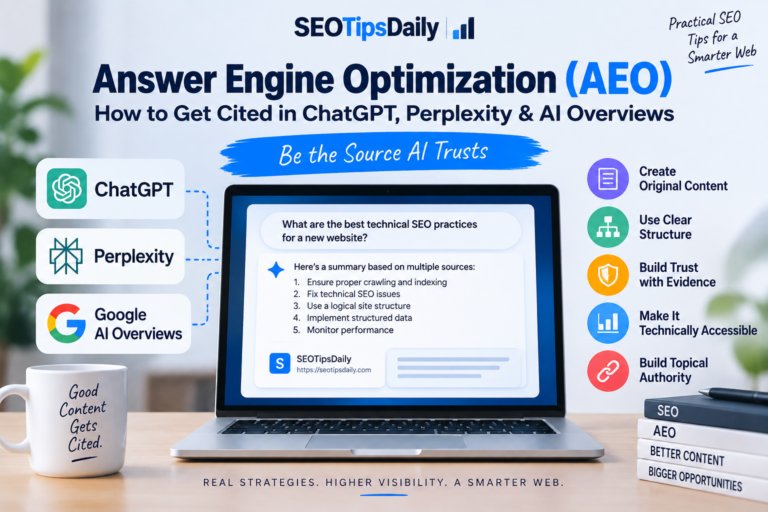
Our guide to answer engine optimization (https://www.seotipsdaily.com/answer-engine-optimization-aeo/) covers related ways to make answers easier to understand.
Add evidence readers can verify
Use original screenshots, documented observations, and attributed research where they improve the explanation. State the tool, date range, country, or test conditions when those details affect interpretation.
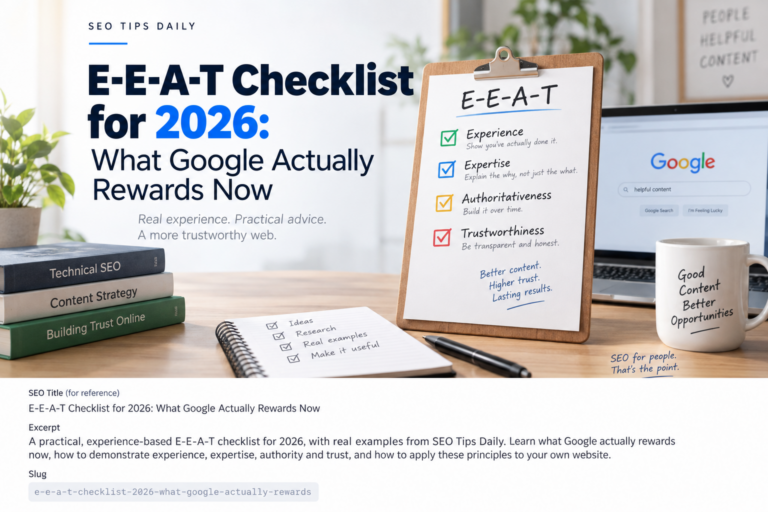
Google’s people-first content guidance (https://developers.google.com/search/docs/fundamentals/creating-helpful-content) encourages useful original contributions and clear sourcing. Apply our E-E-A-T checklist (https://www.seotipsdaily.com/e-e-a-t-checklist-2026/) to strengthen authorship and evidence.
Do not invent an experiment or imply that a routine edit produced measurable growth. A trustworthy explanation is more useful than an unsupported success story.
Strengthen Brand and Local Business Information
Accurate business details help customers identify your organization and choose a next step. Maintain clear information across your website and profiles you legitimately control.
For an eligible local business, keep its name, contact details, location, hours, services, and website current. Correct conflicting information and avoid adding locations where the business has no qualifying presence.
Make the website’s About and contact information easy to find. Explain who operates the business and who is responsible for its content.
Structured data should describe information readers can actually see. Use appropriate organization, article, product, or business markup where relevant, without claiming that markup guarantees a knowledge panel or AI recommendation.
Measure Visibility Alongside Traffic and Conversions
A useful reporting system separates exposure from outcomes. Combine Search Console, analytics, local profile reporting where relevant, and a repeatable sample of search observations.
Metric — What it helps assess — Main limitation
Search impressions — Recorded search exposure — Not a count of people who read or remembered your answer
Clicks and CTR — Website visits relative to impressions — Influenced by position, intent, device, and result layout
Branded queries — Searches involving your name — Cannot establish which earlier exposure created demand
Observed AI mentions and citations — Presence in sampled answers — Results vary; a sample is not total market coverage
Profile interactions — Actions available through a local listing — An interaction is not necessarily a completed sale
Qualified leads and conversions — Tracked business outcomes — Attribution may miss later or offline actions
Record a fixed query set, market, device, date, and observation method for visibility reviews. Distinguish a linked citation from an unlinked mention and verify that the statement is accurate.
Search Console’s Web performance reporting includes Google’s AI-feature traffic, but it does not reveal the total number of zero-click searches for your topic. An impression with no recorded click is not proof that the person received a satisfactory answer.
According to Google Business Profile’s performance guidance (https://support.google.com/business/answer/9918094), its Calls metric counts call-button clicks. It does not measure answered calls or confirmed customers.
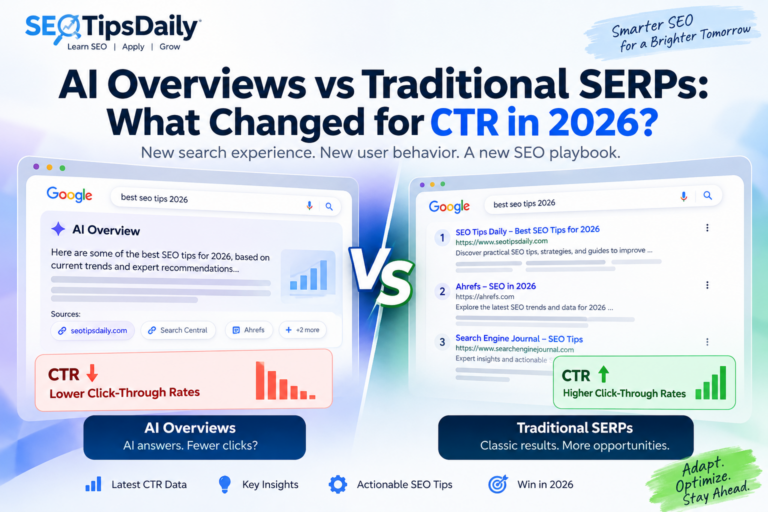
When investigating declining CTR, compare similar queries, countries, devices, and periods. Check rankings, seasonality, titles, and search layouts before attributing a change to AI. Our article on AI Overviews and traditional SERP CTR (https://www.seotipsdaily.com/ai-overviews-vs-traditional-serps-ctr/) explores this context.
Put Your Zero-Click Search Strategy Into Practice
Start with a small, repeatable process. The following 30-day schedule is an implementation plan, not a promise of ranking improvements.
Days 1–7: Establish the baseline
Choose five important queries covering definitions, practical problems, and buying decisions. Record relevant pages, search performance, visible features, and current conversion actions.
Days 8–14: Improve the answers
Update one or two useful pages. Add a direct explanation, clearer headings, relevant evidence, and internal links. Check indexing and mobile usability.
Days 15–21: Build reasons to visit
Add something a short answer cannot fully replace: a calculator, downloadable checklist, worked example, detailed comparison, or troubleshooting walkthrough. Connect it to a relevant next action.
Days 22–30: Review what changed
Repeat the observations under comparable conditions. Review recorded visibility, clicks, engagement, and business outcomes. Treat early changes cautiously and continue monitoring when the sample is small.
Frequently Asked Questions
Does zero-click visibility always benefit a business?
No. Its value depends on recognizable exposure, audience relevance, and the business model. A local service may gain useful inquiries, while an advertising-funded publisher may lose valuable visits.
Does schema guarantee an AI citation?
No. Structured data can describe supported page information, but it does not guarantee an AI citation or search appearance. Google does not require special schema for AI Overviews or AI Mode.
Can Search Console measure zero-click searches?
Search Console measures your site’s recorded search performance, not all searches that ended without clicks. Use it alongside repeatable result observations and business tracking; do not label its unclicked impressions as confirmed zero-click searches.
How can you encourage worthwhile website visits?
Give people additional utility after answering the initial question. Tools, practical examples, deeper comparisons, and personalized next steps create legitimate reasons to visit without hiding the answer.
Conclusion
An effective zero-click search strategy makes useful information discoverable and measures what that exposure actually contributes. Clear answers, accessible pages, accurate business information, and evidence support that work.
Choose five important queries this week. Record a baseline, improve one relevant page, and track visibility alongside visits and qualified outcomes. What part of the process would you like SEO Tips Daily to explain next?