AI Overviews vs Traditional SERPs: What Changed for CTR in 2026?
Google rankings used to follow a fairly predictable formula.
Rank higher, earn more visibility, get more clicks.
That relationship still exists in 2026, but it has become far less straightforward.
Google’s search results increasingly include AI Overviews, AI-powered answers, Featured Snippets, People Also Ask results, videos, shopping modules and other SERP features before users reach traditional organic listings.
For SEO professionals and website owners, this creates an important question:
If you’re still ranking on page one, why aren’t you necessarily getting the same number of clicks?
The answer is increasingly connected to what happens before a searcher reaches your blue link.
In this guide, we’ll examine how AI Overviews are changing organic click-through rates (CTR), why traditional rankings alone no longer tell the entire story, and what website owners should focus on in 2026.
What Is an AI Overview?
An AI Overview is Google’s AI-generated response that can appear directly within search results.
Instead of simply displaying ten organic links, Google may synthesize information from multiple sources and provide an answer directly on the search results page.
AI Overviews can also contain links and citations that allow users to explore the sources behind the generated response.
This creates a different search journey.
A traditional search might look like:
Search → SERP → Website → Answer
An AI Overview can change that journey to:
Search → AI-generated answer → optional website visit
That word — optional — is one of the biggest changes SEO professionals need to understand.
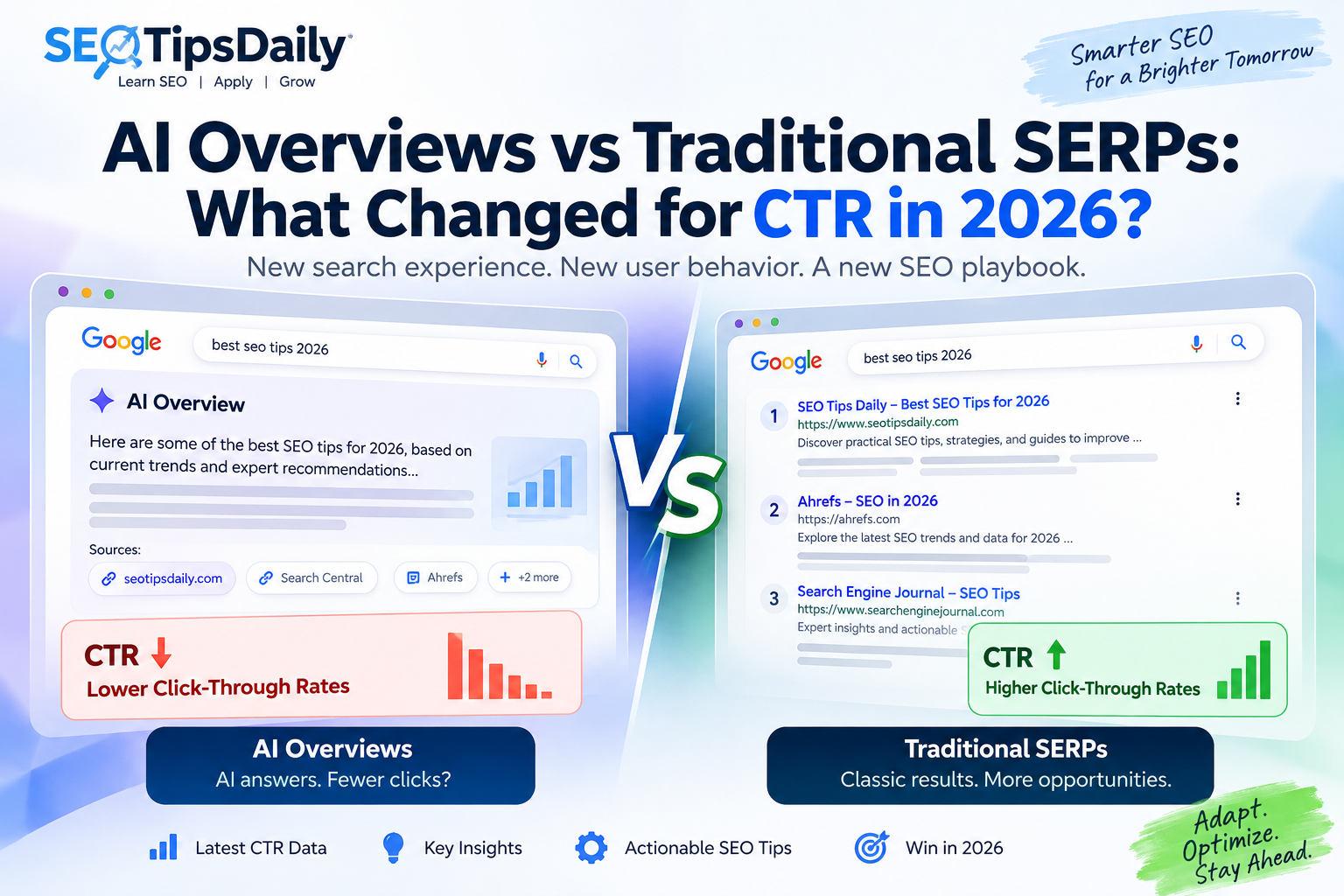
AI Overviews vs Traditional SERPs
Traditional organic search results primarily encouraged users to choose a website that could answer their question.
AI-powered search can attempt to answer part or all of the question before the user leaves Google.
Consider someone searching:
“What is canonicalization in SEO?”
On a traditional SERP, the user may see several articles explaining canonical tags and choose one.
With an AI Overview, Google may explain the concept immediately and provide supporting sources.
If the searcher only wanted a definition, the search could end there.
But if they need implementation instructions, examples, troubleshooting or deeper analysis, they may still click through.
This distinction is becoming extremely important.
Simple answers are increasingly vulnerable to zero-click behavior. Deeper problems still create reasons to visit websites.
What Happened to Organic CTR?
Several industry studies indicate that the presence of AI Overviews can substantially reduce clicks to traditional organic listings.
Ahrefs’ updated 2026 analysis found that when an AI Overview was present, clicks to the top organic result were approximately 58% lower than for comparable searches without an AI Overview.
Earlier Ahrefs research from 2025 had estimated a roughly 34.5% reduction, suggesting that the relationship between AI Overviews and organic clicks has continued to evolve.
The exact percentage should not be treated as a universal CTR benchmark. Different methodologies, industries, query types and SERP layouts can produce significantly different results.
The broader trend, however, is difficult for SEOs to ignore:
An organic ranking can generate fewer clicks when an AI-generated answer occupies significant SERP real estate above it.
That doesn’t mean rankings have become worthless.
It means ranking position and traffic are no longer as tightly connected as they once were.
2026 Data Shows a More Complicated Picture
The story isn’t simply “AI Overviews killed CTR.”
Newer data suggests something more interesting.
Seer Interactive’s 2026 CTR analysis examined 5.47 million queries and 2.43 billion organic impressions across 53 brands.
Their research found that CTR declines associated with AI Overviews appeared to stabilize in early 2026 after significant compression throughout 2025.
For informational queries, Seer’s analysis estimated approximately:
| Search situation | Organic clicks per 1M impressions |
|---|---|
| No AI Overview | ~33,500 |
| AI Overview + brand cited | ~20,743 |
| AI Overview + brand not cited | ~9,445 |
The important finding isn’t merely that AI Overviews reduce traditional clicks.
It’s that being cited within the AI Overview appears to matter significantly.
Seer’s research found that being cited generated roughly 120% more organic clicks per impression than appearing on an AI Overview SERP without being cited.
However, correlation doesn’t automatically prove that the citation itself caused all of that improvement. Stronger brands and authoritative websites may also be more likely to earn citations in the first place.
Still, the practical lesson is important.
SEO visibility in 2026 increasingly includes two objectives:
Rank in organic search AND become a source that Google’s AI systems consider useful enough to reference.
Why AI Overviews Reduce CTR
There are several reasons AI-generated search experiences can reduce traditional organic clicks.
1. Users Can Get Immediate Answers
Many informational searches don’t require a 2,000-word article.
Questions such as:
- What does CTR mean?
- What is robots.txt?
- What is keyword cannibalization?
- What does a canonical tag do?
can often be answered in a few sentences.
If Google provides a satisfactory response immediately, there may be little reason for the user to click another result.
2. Organic Results Can Be Pushed Further Down
Ranking #1 organically doesn’t necessarily mean being the first thing users see.
A modern SERP might contain:
AI Overview → Ads → Featured elements → People Also Ask → Organic results
The website can technically rank first organically while occupying significantly less visual prominence.
That is why rank tracking without SERP-feature tracking can produce misleading conclusions.
3. Search Behavior Is Becoming More Conversational
Searchers are increasingly comfortable entering longer, more specific questions.
Instead of:
SEO audit
someone might search:
Why did my organic traffic decline even though my Google rankings haven’t changed?
AI-powered search experiences are particularly suited to these complex questions because they can synthesize information from multiple sources.
Google says its AI features may use a technique called query fan-out, performing multiple related searches across subtopics and data sources before generating a response.
That creates opportunities for websites that thoroughly cover specific subtopics — even when they aren’t necessarily the most obvious result for the original query.
The Rise of Zero-Click Search
A zero-click search occurs when someone searches but doesn’t click through to an external website.
Zero-click searches existed long before AI Overviews.
Google has provided direct answers through features such as:
- Featured Snippets
- Knowledge Panels
- Weather results
- Calculators
- Currency conversions
- Definitions
- Local results
AI Overviews expand this concept because they can generate detailed responses to questions that previously required visiting one or several websites.
For publishers, this means informational content needs to provide something beyond a definition that can easily be summarized.
Does Ranking #1 Still Matter in 2026?
Absolutely — but marketers should stop treating ranking position as the only measurement of SEO success.
Suppose two keywords each generate 100,000 impressions.
Keyword A
- Position: #1
- AI Overview present
- CTR: 1.5%
Traffic:
1,500 visits
Keyword B
- Position: #3
- No AI Overview
- CTR: 4%
Traffic:
4,000 visits
The lower-ranking keyword generates considerably more traffic.
This is why modern SEO analysis should evaluate:
Ranking + impressions + CTR + SERP features + conversions
rather than rankings alone.
Informational Keywords Face the Greatest Pressure
Not every search query is equally affected.
Informational queries are particularly exposed because AI can often provide the requested information directly.
Examples include:
“What is technical SEO?”
“What is schema markup?”
“What does domain authority mean?”
Commercial and transactional searches behave differently.
Someone searching:
“best SEO audit tools for ecommerce websites”
may want comparisons, screenshots, pricing, limitations and real-world testing.
Someone searching:
“hire technical SEO consultant”
still needs to evaluate actual businesses or professionals.
AI can assist with those decisions, but it cannot completely eliminate the need to visit websites.
This means search intent becomes even more important in 2026.
Traditional SEO Isn’t Dead — Its Job Is Expanding
Every major change in Google Search seems to generate claims that “SEO is dead.”
AI Overviews haven’t made SEO irrelevant.
Google itself states that the foundational SEO practices used for traditional Search remain relevant for AI Overviews and AI Mode.
Pages generally need to be indexed and eligible to appear in Google Search to be eligible as supporting links in these AI experiences.
Google also says there is no special AI schema or additional technical requirement required to appear.
The fundamentals therefore remain important:
- Crawlability
- Indexability
- Internal linking
- Helpful content
- Page experience
- Relevant structured data
- High-quality images and videos where appropriate
- Clear website architecture
What’s changing is what happens after Google understands your content.
How to Optimize for AI Overviews in 2026
There is no guaranteed method for earning an AI Overview citation.
However, several practices make content more useful both to searchers and search systems.
1. Answer the Main Question Immediately
Don’t force users to read 800 words before receiving an answer.
If your heading asks:
What Is an AI Overview?
provide a concise answer immediately underneath it.
Then expand with context, examples and supporting evidence.
A useful structure is:
Question → concise answer → explanation → evidence → example
This makes content easier for humans to scan and easier for search systems to interpret.
2. Build Content Around Subtopics, Not Just Keywords
Google’s documentation explains that AI features can use query fan-out to explore related searches.
That makes comprehensive topical coverage valuable.
For example, an article targeting AI Overview CTR could naturally cover:
- AI Overview CTR statistics
- Traditional SERP CTR
- Zero-click searches
- AI citations
- Informational vs transactional queries
- Search Console measurement
- CTR optimization
- AI Mode
- Organic visibility
Don’t repeat the primary keyword 30 times.
Build the best resource around the underlying problem.
3. Add Information AI Can’t Easily Reproduce
Generic information is increasingly commoditized.
Original information is much harder to replace.
Consider adding:
- Original experiments
- Screenshots
- Search Console data
- Case studies
- Expert observations
- Original statistics
- Templates
- Checklists
- Before-and-after examples
Instead of publishing another article titled:
“10 SEO Tips for Beginners”
publish something such as:
“We Analyzed 500 Search Console Queries After AI Overviews Appeared — Here’s What Happened to CTR.”
The second article has a reason to exist.
4. Make Claims Verifiable
If you state:
“AI Overviews reduce CTR by 58%,”
tell readers where that figure came from.
Strong content should distinguish between:
facts, third-party research, Google’s statements, and your own interpretation.
This improves credibility and makes the article more useful as a reference.
5. Strengthen E-E-A-T Signals
Google’s quality systems increasingly reward content that demonstrates genuine usefulness and credibility.
Make authorship clear.
Where appropriate, include:
- Author biography
- Relevant experience
- Editorial standards
- Sources
- Publication date
- Updated date
- About page
- Contact information
Don’t manufacture experience.
Demonstrate the experience you actually have.
6. Target Queries Where Users Still Need the Website
This may be one of the biggest SEO opportunities of 2026.
Don’t abandon informational keywords, but balance them with searches that naturally require deeper interaction.
Examples include:
Comparison queries
“Ahrefs vs Semrush for technical SEO”
Problem-solving queries
“Why are indexed pages suddenly disappearing from Google?”
Commercial investigation
“Best SEO tools for small businesses”
Implementation queries
“How to fix canonical URLs in WordPress”
Original research
“AI Overview CTR study”
These searches provide stronger reasons to click beyond an AI-generated summary.
7. Optimize for the Click, Not Just the Ranking
When clicks become scarcer, earning the click becomes more important.
A title such as:
AI Overviews CTR
communicates the topic.
But:
AI Overviews vs Traditional SERPs: What Changed for CTR in 2026?
creates a stronger information gap.
Good titles should communicate:
relevance + specificity + benefit
without becoming clickbait.
How Should You Measure SEO Success in 2026?
SEO reporting needs to evolve alongside search.
Don’t evaluate performance using rankings alone.
Track:
Impressions
Is Google continuing to expose your content to searchers?
CTR
Are those impressions converting into visits?
AI Visibility
Does your site appear or receive citations within Google’s generative search features?
Organic Sessions
How much traffic ultimately reaches the website?
Engagement
What happens after visitors arrive?
Conversions
Are organic visitors becoming subscribers, leads or customers?
Google has also expanded Search Console reporting in 2026 to provide dedicated visibility into generative AI features, giving site owners more insight into their exposure within AI-powered search experiences.
This makes it increasingly possible to separate the question:
“Are we visible?”
from:
“Are people clicking?”
Those are no longer the same metric.
The New SEO Funnel
Traditional SEO often looked like:
Keyword → Ranking → Click → Conversion
The emerging search funnel is more complicated:
Query → AI answer → brand exposure/citation → click → website experience → conversion
Sometimes the click won’t happen immediately.
A user might encounter your brand inside an AI-generated result, remember it and search for the brand later.
That makes branded search demand, assisted conversions and overall search visibility increasingly important alongside last-click organic traffic.
What Should SEO Teams Prioritize Now?
The biggest mistake would be trying to “beat AI” by producing even more generic content.
AI is exceptionally good at summarizing generic information.
Instead, create material worth referencing.
Focus on:
Originality.
Publish information competitors don’t have.
Experience.
Show what actually happened when you implemented something.
Depth.
Answer the next question before readers need another search.
Evidence.
Support important claims with trustworthy sources.
Structure.
Make answers easy to understand and extract.
Intent.
Prioritize queries where users have a genuine reason to visit your website.
This is not abandoning traditional SEO.
It is adapting traditional SEO to a search environment where answers can appear before clicks.
AI Overviews vs Traditional SERPs: The Bottom Line
AI Overviews have changed organic CTR.
Research across millions of searches indicates that traditional organic results generally receive fewer clicks when AI-generated answers occupy the SERP.
But the story isn’t simply about losing traffic.
The search ecosystem is creating another layer of visibility.
Websites now have the opportunity to:
rank organically, appear as AI sources, build brand recognition and capture high-intent clicks.
In 2026, the winning question isn’t simply:
“Where do we rank?”
It’s:
“When our audience searches, how visible are we across the entire search experience — and does that visibility ultimately create business value?”
SEO isn’t disappearing.
The definition of search visibility is expanding.
Frequently Asked Questions
Do AI Overviews reduce organic CTR?
Research from multiple SEO datasets indicates that searches containing AI Overviews often generate lower CTR for traditional organic listings than comparable searches without them. The size of the impact varies substantially by query type, industry, ranking position and whether the website is cited within the AI Overview.
How much do AI Overviews reduce clicks?
Ahrefs reported in its 2026 analysis that clicks to the top organic result were approximately 58% lower when an AI Overview appeared compared with similar searches without one. This should be treated as a study-specific benchmark rather than a universal percentage for every website.
Can websites get traffic from AI Overviews?
Yes. AI Overviews can include supporting links to external websites. Seer Interactive’s 2026 research also found substantially higher CTR for brands cited within AI Overviews compared with brands appearing organically on the same types of SERPs without receiving a citation.
Can you optimize specifically for Google AI Overviews?
Google says there are no special technical requirements or dedicated schema markup needed for AI Overviews. Existing SEO fundamentals — indexability, helpful content, internal linking, page experience and clear textual information — continue to apply.
Is traditional SEO still relevant in 2026?
Yes. Google’s generative search features rely on information retrieved from its Search index and ranking systems. Traditional technical SEO, content quality, authority and search intent therefore remain important.
Are informational keywords still worth targeting?
Yes, but informational content needs to provide more value than a basic definition. Original research, practical examples, first-hand experience, templates, tools, comparisons and detailed implementation guidance provide stronger reasons for users to click.
What SEO metrics matter most in 2026?
Rankings remain useful, but they should be evaluated alongside impressions, organic CTR, AI visibility, organic sessions, engagement, conversions and branded search demand.
Final Thought
For years, SEO was largely a competition for rankings.
In 2026, it’s increasingly a competition for visibility, citation, trust and clicks.
The websites that adapt won’t simply ask:
“How do I rank #1?”
They’ll ask:
“How do I become the source both searchers and search engines want to rely on?”
That may be the more important SEO question for the AI-search era.